
Cognitive Wellness at Home
Structured activities to support focus, participation, and mental wellness — no therapy required.
Why is Cognitive Engagement Important?
Many people want meaningful activities to do at home that keep their mind engaged — without committing to formal cognitive therapy.
At Buffalo Occupational Therapy, we help individuals and families choose purposeful, structured activities that support attention, thinking, and participation at the right level — without overwhelm or frustration.
These activities are not therapy.
They are engagement tools, selected using occupational therapy principles.
Who are these at-home cognitive wellness ideas for?
-
Adults who want to stay mentally engaged at home
-
Individuals experiencing mild cognitive changes
-
People who fatigue easily with “brain exercises”
-
Caregivers looking for structured, independent activities
-
Former OT clients wanting continued engagement
-
Anyone who says: “I don’t want therapy — I just want something helpful to do.”
Cognitive Engagement Pathways
We created a simple way to choose at-home activities that match how much thinking you can tolerate on a given day — without it feeling like therapy.
How does this work?
Everyone engages best at a different level depending on energy, attention, and comfort with thinking tasks.
These groupings are not about ability — they describe how much structure or mental effort an activity requires.
You may move between levels depending on the day, the task, or your goals.
How to choose a starting level for yourself:
-
If you want something calming and easy to stay with, start with 🟢 Green.
-
If you want to stay busy with light thinking and clear guidance, start with 🟡 Yellow.
-
If you want to actively challenge your memory and attention, start with 🟠 Orange.
-
If you want a deeper mental challenge and problem-solving, start with 🔵 Blue.
How to choose a starting level for someone you care for:
- If they seem easily frustrated or overwhelmed, start with 🟢 Green.
- If they can follow simple rules and stay focused with guidance, start with 🟡 Yellow.
- If they can remember information and adjust when mistakes happen, start with 🟠 Orange.
- If they enjoy problem-solving and can work independently for longer periods, start with 🔵 Blue.

GREEN – Supported Participation
What this feels like:
“I can do this easily and stay with it.”
Green activities are calming, predictable, and highly guided.
They support participation through repetition, clear visual structure, and hands-on engagement.
Best when you want to:
-
Stay engaged without feeling challenged
-
Reduce frustration or mental fatigue
-
Enjoy an activity that feels steady and doable
These activities usually involve:
-
Clear instructions or visual boundaries
-
Repetition that feels soothing
-
Little to no decision-making
-
Sensory or hands-on movement
Green is about showing up and staying involved — not pushing your thinking.
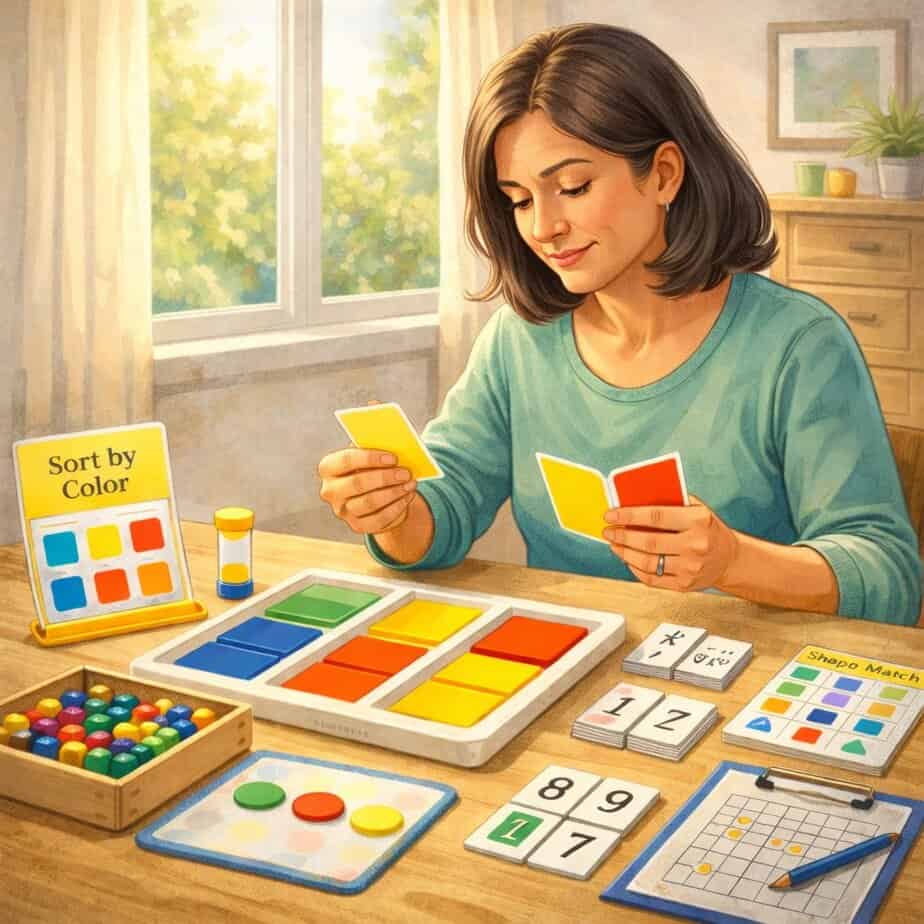
YELLOW- Guided Thinking
What this feels like:
“I have to think a little, but I can see what to do.”
Yellow activities introduce simple choices, matching, or rules — while keeping everything visible and easy to follow.
Best when you want to:
-
Stay busy with purpose
-
Gently challenge your focus
-
Engage your mind without pressure
These activities usually involve:
-
Simple rules or categories
-
Choosing between options
-
Matching, sorting, or sequencing
-
Thinking that stays supported by what you can see
Yellow adds thinking — but without stress or guesswork.

ORANGE- Active Thinking
What this feels like:
“I need to remember, adjust, and stay focused.”
Orange activities require holding information in mind, noticing mistakes, and making changes as you go.
Best when you want to:
-
Work on memory or attention
-
Feel mentally engaged and challenged
-
Use problem-solving skills
These activities usually involve:
-
Remembering information after it’s no longer visible
-
Paying attention to errors and correcting them
-
Following patterns or sequences
-
Sustaining mental effort
Orange is where the brain starts doing more of the work.

BLUE- Strategic and Complex Thinking
What this feels like:
“I’m really using my brain.”
Blue activities involve planning, strategy, and deeper problem-solving.
They are best for people who enjoy challenge and independent thinking.
Best when you want to:
-
Tackle complex problems
-
Build mental endurance
-
Engage in higher-level thinking
These activities usually involve:
-
Multi-step planning
-
Strategy and decision-making
-
Adjusting plans based on outcomes
-
Sustained concentration
Blue is about challenge — not speed, not perfection.